
How Canyon County Warrants Are Issued
The Canyon County Sheriff's Office does not issue arrest warrants. The courts do. A district or magistrate judge signs the order, and the signed warrant is then handed off to the Sheriff's Warrants Unit for entry and service. That split is the core fact behind every Canyon County warrant search. The court is the source. The sheriff is the carrier.
Once a Canyon County warrant arrives at the Warrants Unit, deputies verify the identifiers on the face of the order. They check the date of birth, hair color, eye color, tattoos, and other markers so the record points to the right person. Misidentification is treated as a serious risk, so the unit takes time to confirm the file before it goes live in any database. After the verification step is done, the warrant is entered into local law enforcement systems and into national databases used by police across the country. The file is kept under FBI guidelines, which means routine updates and audits.
When the warrant is served and the person is taken in, a copy of the order is sent to the arresting agency to be read to the offender. Once the Sheriff's Office confirms that copy was received, the original signed warrant is returned to the issuing court for the case file. That is when the Canyon County warrant cycle closes for that order. See the official Canyon County Warrants Unit page for the full process. The page is run by Sheriff Kieran Donahue and is the primary source for warrant questions in the county.
The Warrants Unit page documents process steps that are unusually detailed for a county sheriff's site.
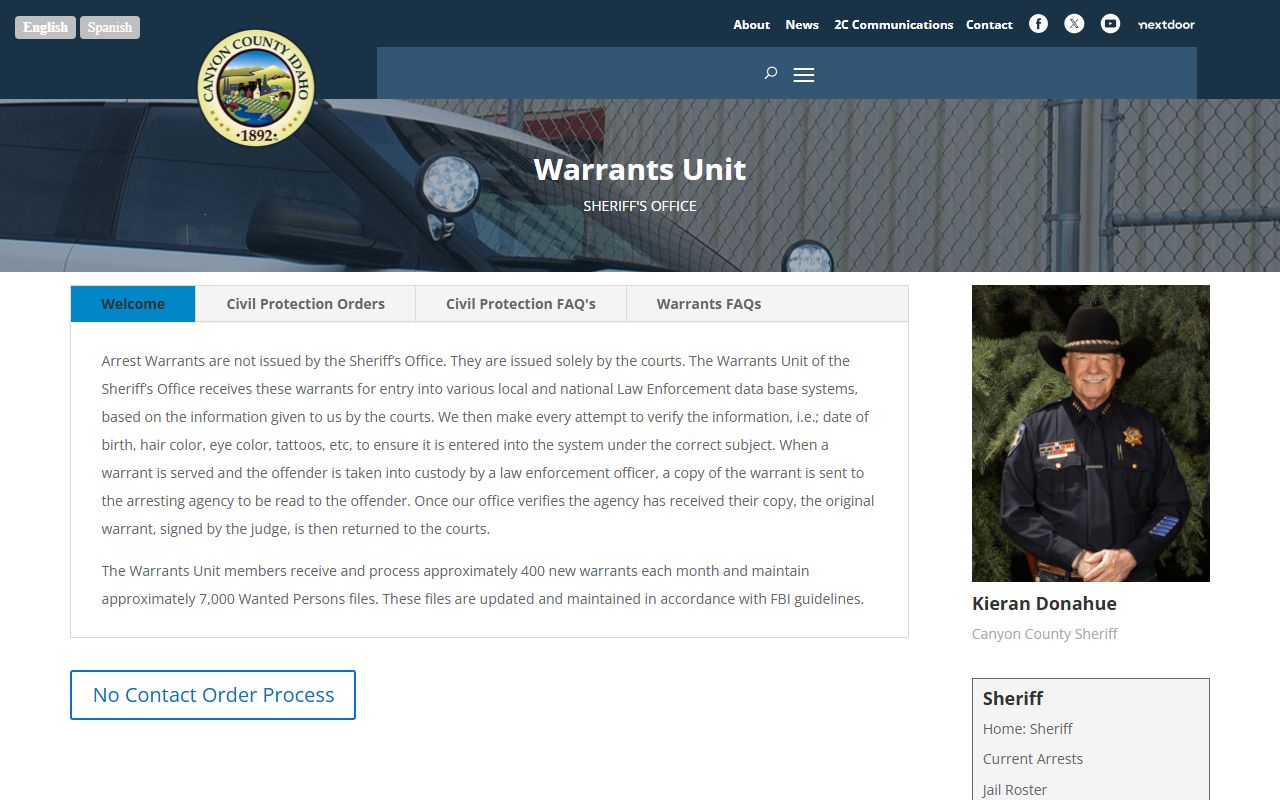
That same page is where the surrender, bond, and civil protection guidance for Canyon County warrants is published.
How to Search for a Canyon County Warrant
The Canyon County Warrants Unit tells the public to use the Idaho court repository, now Idaho iCourt, when looking up a warrant. The portal is the same statewide tool used for general Canyon County case lookups. A name search needs first name, last name, and date of birth. When the system asks whether to include cases with no history or cases with ROAs, pick cases with ROAs. ROA is short for Register of Actions. That is where any warrant entry will appear.
For another person, the unit asks the public to check the county website first, then call the Warrants Unit at 208-454-7273 with a name and date of birth. A name without a date of birth is rarely enough to confirm a Canyon County warrant. The Warrants Unit will not give warrant details to anyone who cannot identify the subject. That rule exists to avoid a wrong match.
- Open the Idaho iCourt Portal at mycourts.idaho.gov and pick Smart Search.
- Enter first name, last name, and date of birth, then narrow the Location filter to Canyon County or the Third Judicial District.
- When the result list shows the case, choose cases with ROAs and open the Register of Actions.
- Scan the ROA for any entry labeled warrant, bench warrant, or capias, then note the issue date and the case number.
- If you still need a yes or no answer on a Canyon County warrant, call the Sheriff's Warrants Unit at 208-454-7273 with the full name and date of birth.
Note: A Canyon County warrant entry on the iCourt Register of Actions is the most direct public confirmation, since there is no separate public list of active warrants.
Canyon County Warrant Search Fields
The Canyon County Warrants Unit gives a short, specific list of fields needed for a name-based warrant lookup in iCourt. The fields are the same ones a deputy uses when matching a subject to a court file. Each field below maps to the iCourt search screen and to the phone-call script used by the Warrants Unit.
| Field Label | Type | Required | Notes |
|---|---|---|---|
| First Name | Text | Yes | Required by the Canyon County Warrants Unit FAQ for an effective lookup. |
| Last Name | Text | Yes | Required by the Canyon County Warrants Unit FAQ for an effective lookup. |
| Date of Birth | Date | Yes | Used to identify the person and to avoid a wrong match. |
| Cases with ROAs | Result option | Important | Pick this option, not cases with no history, so the Register of Actions is shown. |
| Case history / ROA entry | Result detail | n/a | Read the Register of Actions for any warrant-issued entry. |
The combination of name, date of birth, and the ROA option is what the Warrants Unit treats as a real Canyon County warrant search. Without all three, the result set is too broad to trust.
What Appears in a Canyon County Warrant Record
There is no separate Canyon County active warrant database open to the public. Warrant data lives inside the case file in iCourt, as a line in the Register of Actions. The fields below are the ones a reader can expect to see when a Canyon County warrant entry appears in a case ROA. Some fields are not on every order. Bond, for example, is only listed when the judge sets a bond on the warrant.
| Field | What It Shows |
|---|---|
| Case Number | The case the warrant belongs to. |
| Party / Defendant | The named person the warrant is for. |
| Warrant Issue Date | The date the judge signed the order. |
| Warrant Type | Arrest, bench, or search warrant. |
| Issuing Court / Judge | District or magistrate division and the judge's name. |
| Charge or Case Context | The criminal charge or the underlying case reason. |
| Bond / No Bond | Listed if the judge sets a bond amount on the order. |
| Warrant Returned / Served Date | The date the original is returned to the court after service. |
Read the ROA from top to bottom. A new warrant in a Canyon County case is usually preceded by a missed hearing, a failure to appear, a probation violation report, or a fresh criminal complaint.
Types of Warrants in Canyon County
Canyon County warrants fall into a few common types. The legal glossary used by the county court tracks the same labels found in the Idaho Court rules. Each type sits on a court order. Each is served the same way by the Warrants Unit, but the reason behind the order is different.
- Arrest warrant
- A court order that authorizes law enforcement to arrest a named person, based on a criminal complaint or grand jury indictment.
- Bench warrant
- An order issued by a judge from the bench, often after a person fails to appear at a scheduled hearing.
- Search warrant
- An order that authorizes a search of a place or person for evidence; not used to arrest, but tied to active investigations.
- Capias / failure-to-appear warrant
- A bench warrant used to bring a defendant back to court after a missed setting in a Canyon County case.
The Warrants Unit treats every warrant the same way on intake, but the type changes what happens after service. Bench warrants on a small case sometimes resolve with a quick appearance and a recall request. Felony arrest warrants almost always require booking.
The Canyon County Sheriff's Warrants Unit
The Warrants Unit sits inside the Canyon County Sheriff's Office under Sheriff Kieran Donahue. It is the only county team that processes warrant paper for the courts. The unit publishes the most useful public guide to Canyon County warrants on the official sheriff site. It handles roughly 400 new warrants every month. It also keeps about 7,000 wanted-person files current under FBI rules.
The unit is open to phone questions during normal hours. The line is staffed for warrant checks and surrender questions, not for tips, not for case advice. The team also runs the civil side of the Sheriff's Office for civil protection orders and no-contact order standby calls. See the Sheriff Civil and Records page for the civil counter, which sits in the same building.
That civil page also lists the records desk used for sheriff incident reports, traffic crash reports, and the civil side of warrant work.
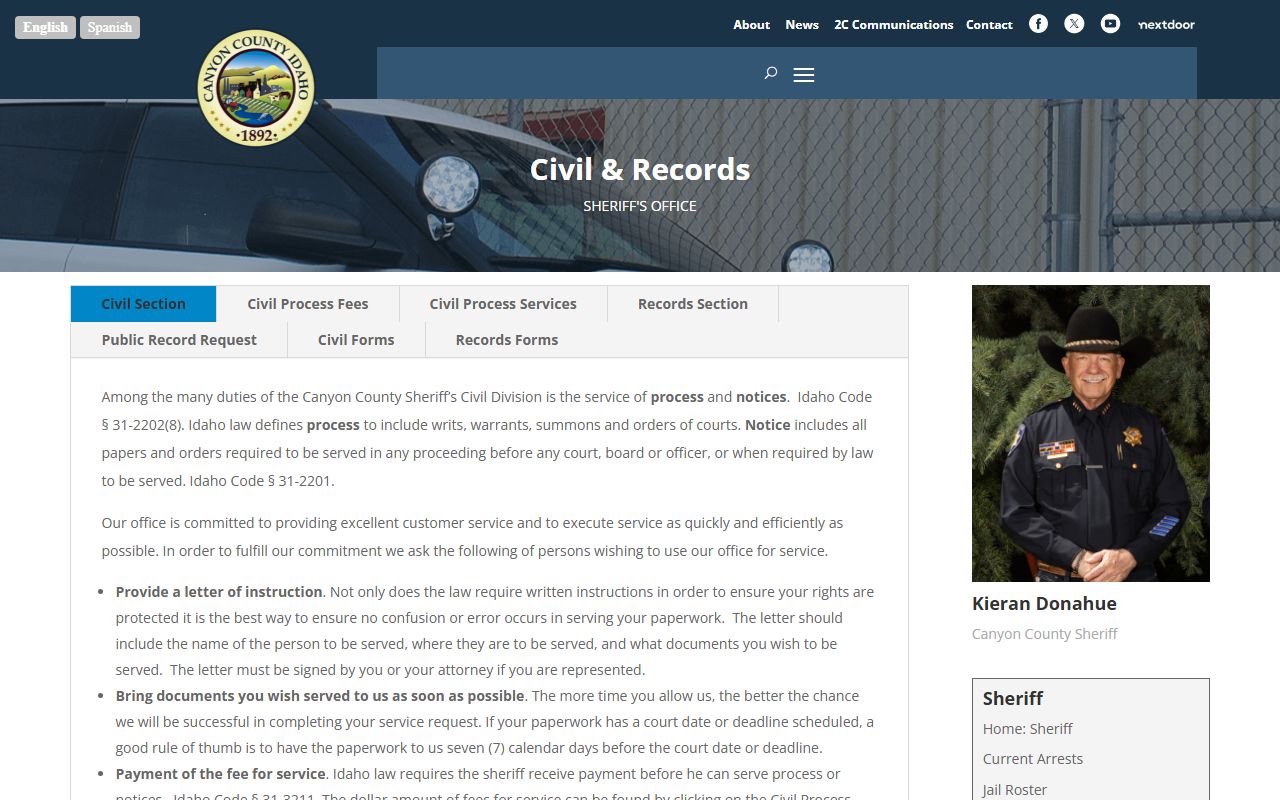
The contact card below lists the direct line for warrant questions.
Canyon County Sheriff's Warrants Unit
1115 Albany St
Caldwell, ID 83605
Warrants Unit: 208-454-7273
Weekdays 8 AM to 5 PM
The same building, at 1115 Albany St, also holds the Canyon County Courthouse and the Clerk's office, so warrant paper and case files do not travel far.
Resolving an Outstanding Canyon County Warrant
The Canyon County Warrants Unit encourages people to come in on their own once a warrant is confirmed. The unit says weekday surrender between 6 AM and 7 AM is the best window, because that timing usually lines up with same-day arraignment. A late-morning surrender on Friday tends to mean a weekend in jail before the next available judge. The unit will not name a bond company. The Sheriff's Office cannot recommend any specific surety. A family member or friend should hold the bond money, since jail personnel will secure valuables during booking.
- Confirm the warrant with the Canyon County Warrants Unit at 208-454-7273 or in the iCourt Register of Actions for the case.
- If a bond is set, arrange the bond money or a bond company in advance; the Sheriff's Office cannot recommend one.
- Plan to turn yourself in on a weekday between 6 AM and 7 AM to see a judge the same day.
- Bring no valuables; have a family member or friend hold cash and any bond money.
- Report to the Canyon County jail intake at the Dale G. Haile Detention Center for booking on the warrant.
- After the booking is done, wait for arraignment at the scheduled time for the age category.
- Once the warrant is served, the Warrants Unit returns the original signed warrant to the issuing court.
Important: Talk to a lawyer before any voluntary surrender on a Canyon County warrant, since bond, charges, and timing all affect outcomes.
Booking and Arraignment Timing After a Canyon County Warrant
Once a Canyon County warrant is served, the next clock is the arraignment clock. In-custody adults, age 18 and up, are arraigned at 1:30 PM. In-custody juveniles, 17 and under, are arraigned at 11:00 AM. Both times run on court days only. A person booked Monday through Thursday may see a judge the same day or the next day. A person booked Friday, Saturday, or Sunday will wait until Monday. If the Monday is a court holiday, the wait runs to Tuesday.
That schedule is why the Warrants Unit pushes the early-morning weekday surrender so hard. Walking in at 6:30 AM on a Tuesday usually puts a person in front of a judge that afternoon. Walking in at 4 PM on a Friday usually means three nights in jail before arraignment. Anyone planning to surrender on a Canyon County warrant should look at the calendar first.
For an active jail check after booking, the Sheriff's Office runs a public roster. Use the Canyon County Jail Roster to confirm intake, or the Canyon County inmate records page for the full search guide. Custody change notifications are also available through Idaho VINE.
Idaho VINE is also the right tool when a Canyon County warrant has already been served and a family member wants alerts when custody status changes.

VINE will send a call or text when a Canyon County inmate is released, transferred, or moved between facilities.
Civil Protection Orders vs No-Contact Orders
The Canyon County Warrants Unit page also covers the line between a Civil Protection Order and a No-Contact Order. People mix these up often. The two orders look similar, but the source, the timing, and the standby rules are not the same. Both involve the Sheriff's Office at some point. Only one of them comes from a criminal case.
| Aspect | Civil Protection Order (CPO) | No-Contact Order (NCO) |
|---|---|---|
| Who starts it | An individual asking the court for protection. | A judge, after a criminal charge has been filed. |
| When it is issued | After the applicant files the CPO paperwork. | At a criminal court appearance. |
| Filing time / place | Civil clerk counter on the 2nd floor of the courthouse, no later than 11:30 AM, Monday through Friday. | Issued in open court as part of the criminal case. |
| Same-day court time | Return at 1:45 PM the same day to see a judge. | Set by the court at the criminal hearing. |
| Contact rules | Stay-away terms set by the judge in the CPO. | No direct contact, and no third-party contact. |
| Civil standby | Only if the judge orders a standby. | Automatic one-time standby if the order says so. |
| Where violations go | Law enforcement where the violation took place. | Law enforcement where the violation took place. |
A violation of either order is a fast route to a new Canyon County warrant. Violations should be reported to the law enforcement agency that covers the place where the contact happened, not always the Canyon County Sheriff.
Active Canyon County Warrant Limits
Canyon County does not publish an open list of every active warrant. There is no county page titled active warrants, and no downloadable file of names. The Warrants Unit treats warrant content as case content. The public route to a Canyon County warrant runs through iCourt and through phone confirmation at 208-454-7273, with a name and date of birth.
Some warrant material can be exempt from open access under Idaho Code 74-106, which protects law enforcement investigatory records. That rule lets the sheriff hold back details that would interfere with an active case, reveal a confidential source, or put a person at risk. ICAR 32, the Idaho Court Administrative Rule on judicial records, controls the court file side. Sealed warrants and juvenile warrants are not visible on the public ROA at all.
Federal warrants are not Canyon County warrants. They sit in the federal system and do not appear in iCourt. A federal arrest may still bring a person into the Canyon County Jail on a hold, but the warrant itself is tracked by U.S. Marshals or the federal agency that filed it, not by the county.