
How to Look Up Canyon County Jail Population Data
Canyon County jail population data lives on the official Jail Statistics dashboard. The dashboard is run by the Sheriff's Office. The page is at canyoncounty.id.gov/jail-statistics-website. The live data app sits at apps.canyoncounty.id.gov/JailStatistics. The county news post says the site updates around 5:15 AM each day. Numbers reflect the early-morning snapshot, not real-time counts.
The Canyon County dashboard has six tabs. They are Canyon County Jail Summary, Population, Facility Classification, Facility Utilization, Other County Housing, and Historical Charts. The Summary tab gives the headline number. The Population tab breaks it down by gender and classification. Facility Utilization shows which pod is full and which has open beds. Other County Housing tracks Canyon County people held outside the county. Historical Charts hold the multi-year trend lines.
The Canyon County Facility Classification page has a Start Date and End Date control. The county notes that data is collected daily for Jail Statistics starting November 1, 2018; earlier data is in the historical charts. A reader can pick a single day or pull a range. Numbers shown are official Canyon County Sheriff's Office counts, not estimates.
The lead-in source is the Canyon County Jail Statistics announcement. It says the dashboard was built so citizens could see daily population, crowding, historical counts, out-of-county housing numbers, and costs.
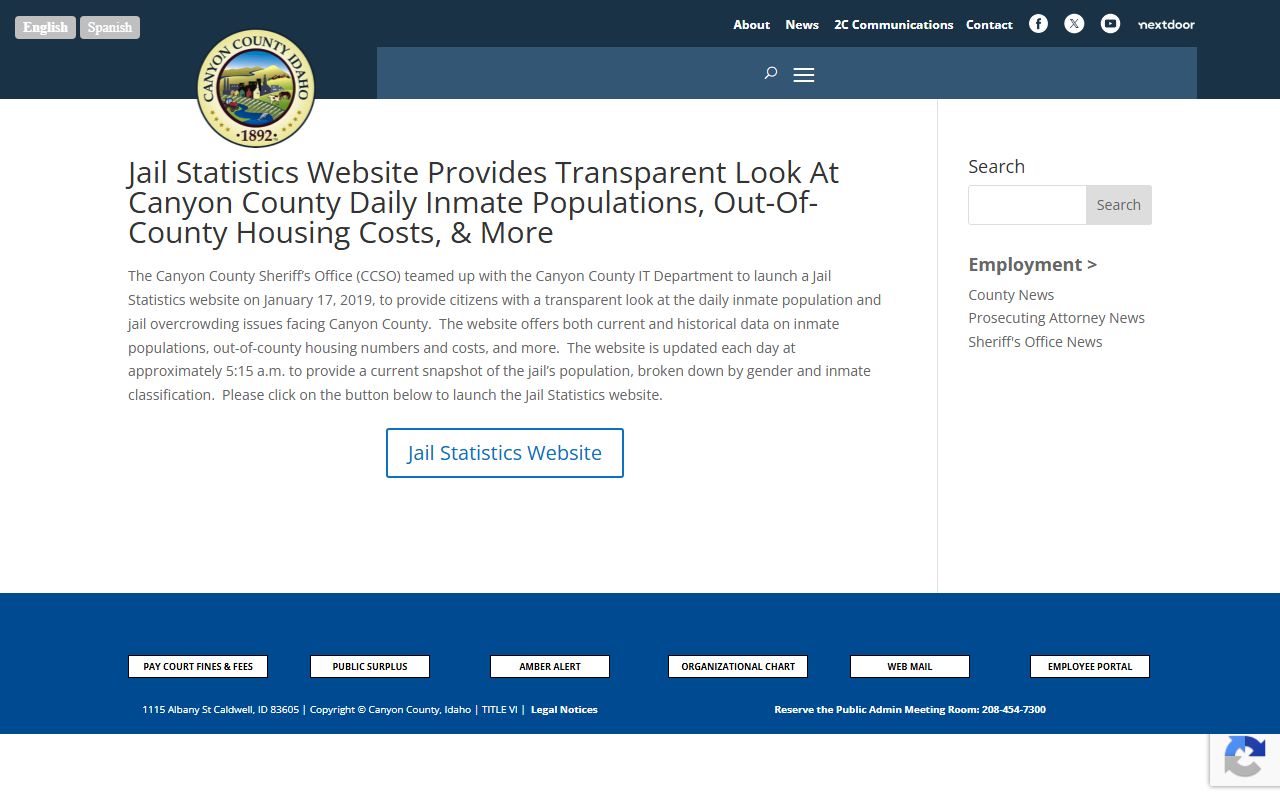
The same county news post is the cleanest plain-English summary of what the dashboard covers and when it refreshes. It is a useful first stop before opening the live app.
Canyon County Jail Capacity Overview
Canyon County runs three adult jail facilities, all in Caldwell. Total rated Canyon County adult jail capacity across them is 477 beds. The numbers come from the Canyon County Sheriff's current jail facilities page. The Canyon County mix of buildings matters: one is modern, one is from 1948, and one started as a tent.
| Facility | Built / Opened | Rated Capacity | Notes |
|---|---|---|---|
| Dale G. Haile Detention Center | Built 1991; opened 1993 | 321 total; target population 256 | Main holding building; 40 beds set aside for work release; 34 special management units used mostly for booking. |
| Jail Annex | Opened 1948 | 34 | Old design; inmates split across two floors; two deputies needed to monitor up to 34. |
| Tent Facility (Pod 5) | Opened 2006 | 122 | Started as a work-release site; now minimum-security general population due to crowding; hardened after 2016-2018 escapes. |
The 477 total is the headline number. The Dale G. Haile target of 256 is the figure jail staff watch most closely. Anything over 256 in the main building pushes inmates into the Annex and the Tent Facility. At some point it pushes people out to other Idaho counties. The Sheriff's Office uses the target as a staffing and safety benchmark.
- Total adult jail capacity
- 477 beds across Dale G. Haile, Jail Annex, and Tent Facility.
- Dale G. Haile target operational population
- 256 beds, the level the main building is set up to run safely day to day.
- Gap between target and full
- 65 beds in the main building before hitting the 321 rated cap. Another 156 beds sit in the Annex and Tent Facility before the county hits its 477 ceiling.
Daily Population Snapshots and Update Time
Each morning around 5:15 AM, the Canyon County Jail Statistics dashboard pulls a fresh snapshot. The Canyon County snapshot is a single point in time. People booked later that day will not show up until the next morning's pull. Releases work the same way. That cadence keeps the data clean but it also means the page is not a live roster.
The Population tab breaks the daily count down by gender and by inmate classification. Classification covers items like booking, general population, work release, special management, and out-of-county housing. The Facility Classification tab maps those groups onto buildings. A reader looking at the Tent Facility row knows that block is minimum-security and that any movement in or out of Pod 5 ties back to crowding in the main building.
Note: the Jail Statistics dashboard publishes once a day, so a person booked at noon will not appear in the count until the next 5:15 AM refresh.
Population Classification and Gender Breakdown
The Canyon County dashboard groups Canyon County inmates by classification and by gender. Classification is the operational label used by the Sheriff's Office. It is not a legal status. A person can share the same legal status (say, pretrial) and fall into different Canyon County classification buckets. The split is based on housing, security risk, work-release eligibility, or medical needs.
Common classification buckets used at the Canyon County Jail include the following.
- Booking and intake (the 34 special management units at Dale G. Haile are used mostly here).
- General population in Dale G. Haile.
- Minimum security in the Tent Facility / Pod 5.
- Work release at Dale G. Haile (40 beds set aside).
- Jail Annex housing across the building's two floors.
- Other county housing for inmates the Canyon County Jail cannot hold in-county.
Gender breakdown is its own line on the Canyon County Population tab. Female Canyon County inmates are a smaller share of the daily count, which is part of the reason the county is moving toward a separate women's facility. The Canyon County Sheriff's Office has not posted an exact daily female ratio on the static announcement page; the current ratio shows in the live Population tab.
The Canyon County inmate population data file does not publish a race or age breakdown on the public dashboard pages reviewed. A reader who needs that detail has to go through a public records request to the Sheriff or the Idaho Courts compiled data process.
Pretrial vs Sentenced Population
The pretrial vs sentenced split is one of the most useful numbers in any jail data set. Pretrial means a person is held while a case is open. Sentenced means a person is serving a jail term after a plea or verdict. The Canyon County Jail Statistics dashboard tracks both groups by classification. The exact daily ratio shifts.
The Sheriff's Office and the courts treat the two groups differently. Pretrial inmates are eligible for bond. They can move out on personal recognizance. They can also be moved into Pretrial Release or Intensive Community Supervision programs noted on the Canyon County jail roster disclaimer. Sentenced Canyon County inmates may be in work release, on the Sheriff's Inmate Labor Detail, or simply serving time at Dale G. Haile or the Tent Facility.
Note: jail roster charges do not always match the final filed charges from the Prosecuting Attorney, so the pretrial count is a custody count, not a case-filing count.
Facility Utilization and Overcrowding
Canyon County jail overcrowding is not a new topic. The county's own news posts call it out, and the Tent Facility's history is the clearest example. Pod 5 opened in 2006 as a work-release site. It later became minimum-security general population because the rest of the jail was full. After a stretch of escapes between 2016 and 2018, the Tent Facility was hardened.
Facility Utilization on the Canyon County dashboard shows how many beds are filled at each building. When Dale G. Haile pushes past its 256 target, Canyon County inmates flow first into the Tent Facility, then into the Jail Annex, and finally into other-county housing. The order is partly about cost and partly about classification: minimum-security Canyon County inmates can be moved to Pod 5, but higher-risk people stay in the main building.
Long-term, the women's jail project on Pond Lane is meant to take pressure off the main building. A first phase of up to 192 female beds would move female inmates out of Dale G. Haile and free up space for general male housing. That plan was the subject of the March 20, 2025 open house at The Center, 110 County Fair Ave in Caldwell.
Jail Annex Staffing Constraints
The Jail Annex is the staffing-cost outlier in the Canyon County jail system. It opened in 1948 and was not designed as a modern Canyon County jail. Canyon County inmates are split across two floors. The Canyon County Sheriff's facilities page notes that two deputies are required to monitor up to 34 inmates in the Annex. That deputy-to-inmate ratio is what makes the Annex expensive to run on a per-bed basis.
By contrast, Dale G. Haile was built in 1991 and opened in 1993 with sightlines and pods that let staff cover more beds per deputy. The Tent Facility, even after the 2016-2018 hardening, is a minimum-security block where staff watch a single open space. Annex staffing is the reason the 34 beds in that building are not a simple add-on to the 321 in Dale G. Haile. Pulling the Annex offline would save deputy hours but cut total Canyon County jail capacity from 477 to 443.
Note: deputy staffing levels affect classification, housing decisions, and out-of-county housing costs, which is why the Annex shows up in nearly every Canyon County jail planning report.
Other County Housing and Costs
When the Canyon County Jail hits capacity, some inmates are sent to other Idaho county jails for housing. The Jail Statistics dashboard has a dedicated Other County Housing tab. The tab tracks how many Canyon County inmates are held outside the county and the cost the county pays per day. Out-of-county housing is one of the main pressures driving the women's jail project and the broader capacity debate.
Idaho law sets up a reimbursement path that runs the other direction. Idaho Code 20-607 lets the sheriff recover up to $25 per day from a sentenced prisoner held in the county jail, with a $500 cap per case. That cap is low. The statute does not come close to covering the real cost of holding a person. That is especially true when the person is housed out of county at a contract rate.
Lead-in source: the Idaho jail reimbursement statute is cited directly by the Canyon County Detention Center page. The cite covers the medical and housing fees a sentenced jail prisoner may owe.
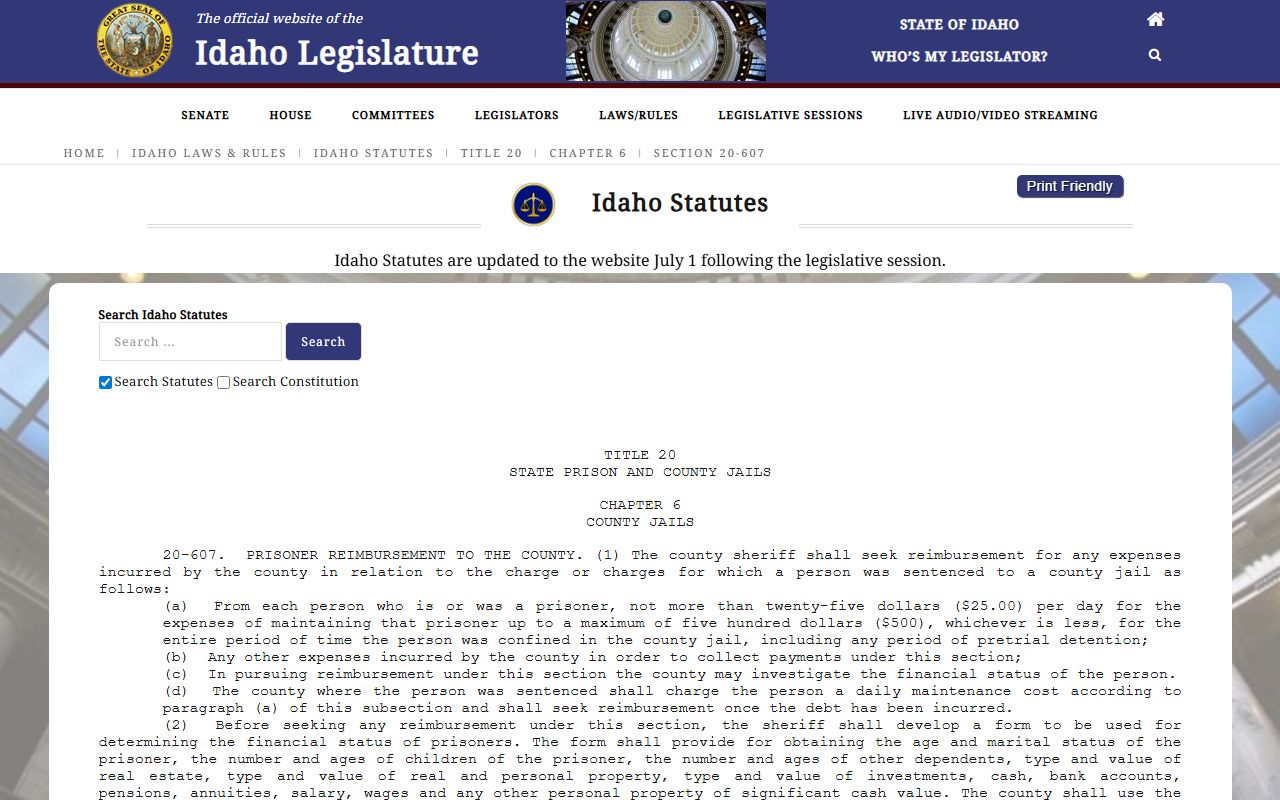
The statute helps explain a real budget gap. The county still loses money on each day a Canyon County inmate is housed out of county. The maximum recovery from a sentenced prisoner is capped well below the actual per-day cost.
The Women's Jail Project on Pond Lane
Canyon County is in the early stages of a phased women's jail facility on a 26-acre property at Pond Lane in Caldwell. The county bought the Pond Lane site in 2007 as a potential jail site after four bond measures failed. The plan sat for years. In 2025, the Board of County Commissioners moved on it again and held a public open house on March 20, 2025 at The Center, 110 County Fair Ave.
The first phase of the Canyon County women's facility is sized for up to 192 female beds. That alone is more than the Tent Facility's 122 beds and would shift the gender mix at Dale G. Haile. With female inmates moved into a purpose-built building, the main detention center can be used for male general population, and the Annex's role can be re-thought.
- 1948: Jail Annex opens; still used today on two floors with up to 34 inmates.
- 1991-1993: Dale G. Haile Detention Center is built and opens with 321 beds and a 256 target.
- 2006: Tent Facility (Pod 5) opens as a work-release site; later shifts to minimum-security general population.
- 2007: County buys the 26-acre Pond Lane property in Caldwell after four failed bond measures.
- 2016-2018: Tent Facility hardened after escapes during this window.
- January 17, 2019: Sheriff's Office and IT Department launch the public Jail Statistics website.
- March 20, 2025: Public open house for the phased women's jail at The Center, 110 County Fair Ave, Caldwell.
The county noted free parking across from The Center's entrance off County Fair Ave for the open house. That is the kind of local detail that signals the project is still in public-outreach mode, not under construction.
Searching for Canyon County Inmate Records by Name
Aggregate population data is one thing; name-based custody lookups are another. For name-based searches of who is currently in custody, the live Canyon County inmate records page walks through the official Jail Roster at jailroster.canyoncounty.id.gov and the Current Arrests list. People released from custody are covered on the released inmates page. Active warrants are tracked on the warrant records page.
Where the Jail Statistics Data Comes From
The Canyon County Jail Statistics dashboard is run by the Sheriff's Office in cooperation with the county IT Department. The January 17, 2019 launch announcement on the county website credits both groups. The data is pulled from the same booking and housing system the jail uses internally, then published on a daily lag at roughly 5:15 AM.
Some data sits outside the public tabs. That includes race or age breakdowns, custom date ranges, and per-pod counts not shown by default. Those have to be requested through the Sheriff's Civil and Records office or through the Idaho Courts compiled data process at isc.idaho.gov/media-resources/records-camera-request. Idaho Court Administrative Rule 32 controls judicial-records access for court files. Canyon County jail housing data sits under the Sheriff's records authority and Idaho's Public Records Act.
Note: jail booking data is dynamic, and a one-day count can swing by dozens of beds in a week; trend questions should pull from the Historical Charts tab.
National and State Context
Canyon County jail population data is part of a wider picture tracked at the state and national level. The Bureau of Justice Statistics (BJS) publishes annual jail and prison counts for the United States and for each state. The Vera Institute publishes county-level jail population work in some jurisdictions. BJS and Vera are flagged as comparison sources. Neither was cited with a current Canyon County rate per 100,000. The same gap holds for the current Idaho rate.
That means any per-100,000 number a reader sees should be checked against the source publication date. State and national jail rates per 100,000 are BJS figures, not Canyon County figures, and they should be labeled that way. Canyon County's own numbers should come from the Jail Statistics dashboard directly. Mixing the two without a label is the most common mistake in jail population reporting.
For court-level context, the Canyon County Jail is part of the Third Judicial District court system. The same case flow feeds the population numbers shown on the Jail Statistics dashboard. Misdemeanor and traffic cases generally do not generate long jail stays. Felony cases handled in Canyon County District Court are the main driver of the sentenced jail count.